AI-powered resume tailoring tool for job-specific optimization
Client
Personal Project
Role
Designer and developer
Duration
1 week (concept → prototype)
Focus areas
UX/UI design, product strategy, interaction design, prototyping, AI-assisted workflow design
Overview
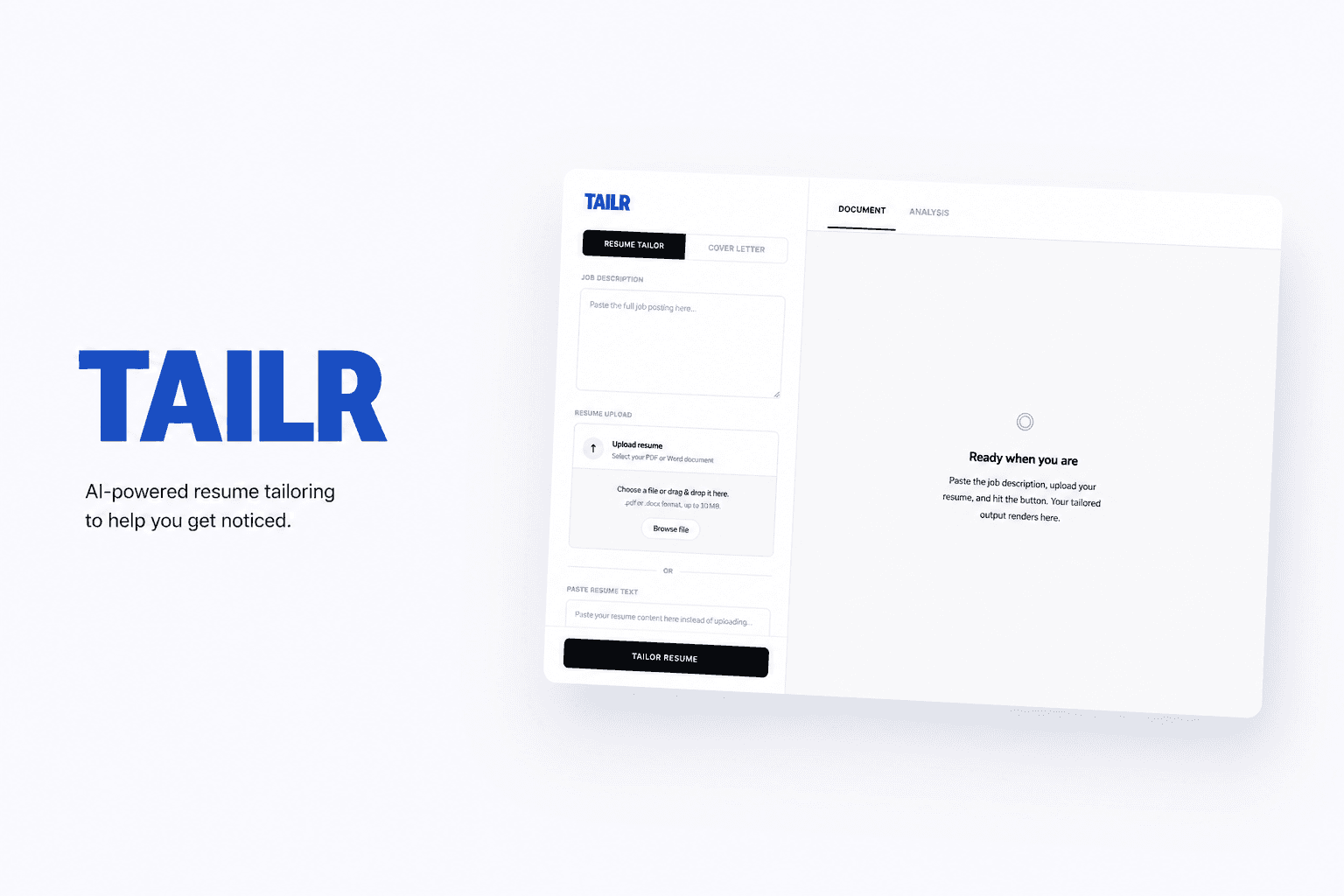
TAILR is a lightweight tool designed to help job seekers quickly tailor their resumes to specific job descriptions.
Instead of manually rewriting resumes for each application, users can input a job description, upload their resume, and instantly generate a more targeted version.
The goal was to reduce friction in the application process while improving alignment with how resumes are evaluated by hiring systems.
The Problem
Job applications often require candidates to tailor their resumes for every role. In practice, this process is:
Time-intensive
Repetitive
Difficult to optimize for ATS systems
Many applicants either reuse the same resume or make small edits that don’t meaningfully improve alignment with the job description.
As a result, strong candidates can be filtered out before reaching a recruiter.
Opportunity
While there are existing tools that help tailor resumes, many of them fall short in a few key areas:
Interfaces are often cluttered or unintuitive
Customization is limited, making it hard to adapt outputs
ATS-focused feedback is either hidden, overly complex, or not easily accessible
This creates friction in a process that should be fast and repeatable.
There’s an opportunity to design a more streamlined experience, one that combines clear inputs, flexible editing, and accessible ATS alignment in a single, focused workflow.
The goal was not just to generate a resume, but to make the process transparent and controllable for the user.
Input → Output Layout
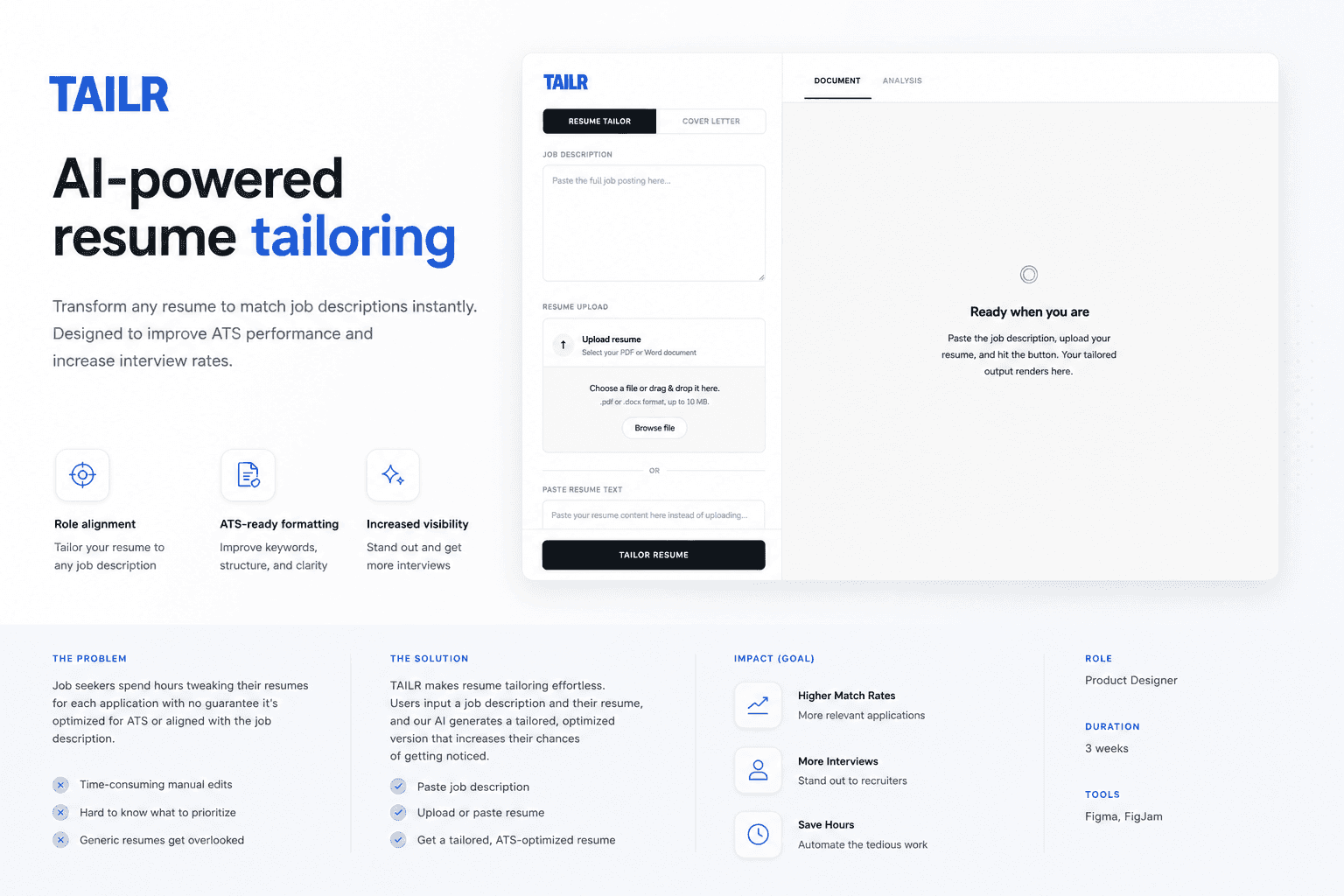
The interface is structured as a dual-panel layout:
Left: user inputs (job description + resume)
Right: generated output
This allows users to clearly understand cause and effect. What they input directly impacts what is generated.